
Approved: from 31 October a Vale councillor gets seven days after consultation closes to ask for a committee hearing, and two people decide. How it works.
From 31 October, a Vale of White Horse councillor who wants a planning application heard in public will have seven calendar days after the consultation closes to ask. The deadline “shall not be extended”.
Even then, the request only starts a test. The application goes to committee only if the council’s director of planning and the chair of the planning committee both agree it is significant enough.
The detail is in the procedure note put to a special meeting of the full council at Abbey House on Wednesday 23 September. The council report asked councillors to adopt it from 31 October.
Updated 2 October: councillors approved the changes. The council said on 28 September that the special meetings of the Vale on 23 September and South Oxfordshire on 24 September agreed them “after a lengthy debate”. The constitutions will be amended to take effect from 31 October. Cllr Emily Smith, the Vale’s cabinet member for planning, called it a “Hobson’s choice”: not adopting the changes would have left the council “facing legal challenges and further loss of control over local planning decisions”. The minutes, with the vote, had not been published on 2 October.
What is going
In August we reported that most planning cases will stop reaching councillors under new national rules. The council said then that its special meeting would settle how the rest would work locally. This is that answer.
The report is blunt about what ends on 31 October. Under the government’s regulations, it says:
- the current councillor call-in process has to be removed
- ward member referrals “can no longer be applied”
- automatic triggers, “such as number of objections”, fall away
- this includes applications already in the system but not decided by 31 October
The regulations leave the council no choice. If it did nothing, the report says, its arrangements “would be in contravention of the legislation” and decisions could be quashed.
Which applications can still reach committee
The national scheme splits applications into two lists.
Schedule 1 applications must be decided by a planning officer. There is no route to committee at all. The list includes:
- householder extensions and alterations
- minor residential schemes of one to nine homes on sites under half a hectare
- minor works to existing buildings already in commercial use
- discharge of conditions and non-material amendments
- lawful development certificates and prior approvals
- most reserved matters applications
Schedule 2 applications are presumed to be decided by officers too. These include major schemes, tree works, listed building consent and advert consent. They are the only ones that can be referred to councillors.
The report notes one local choice. The council’s review group decided not to hand tree and listed building cases to officers automatically, as the current scheme does. They stay in Schedule 2, so they can still be referred.
How the new referral works
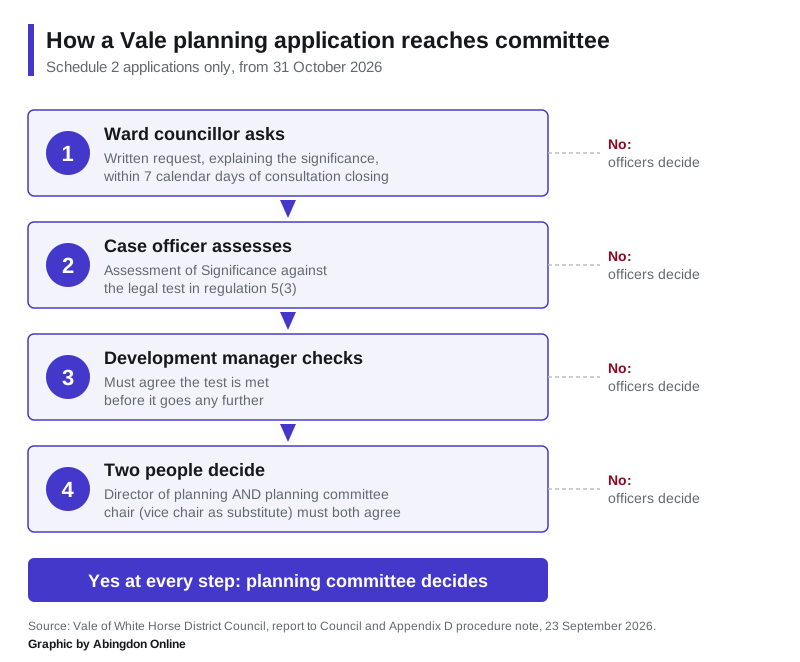
The procedure note calls the request a Gateway Referral Request. Only a ward councillor for the area can make one. It must:
- be in writing
- explain how the scheme meets the legal test of significance
- arrive no later than seven calendar days after public consultation closes
- come from a councillor with no conflict of interest in the application
The legal test is in regulation 5(3) of the government’s regulations. The application must raise an issue of economic, social or environmental significance to the local area, or a significant planning matter under the development plan.
The case officer then writes an Assessment of Significance. If the officer says no, the case stays with officers. If yes, a development manager checks it. If the manager agrees, it goes to the two people who decide.
Those two are the director of planning and the nominated member. The report names the nominated member as the chair of the planning committee, with the vice chair standing in, for the rest of this council year. If they do not both agree, officers decide the application.
What you will be able to see
The note promises a paper trail. For Schedule 2 applications:
- the Assessment of Significance is due on the online case file five weeks into the application
- the gateway decision is published after the meeting that makes it, before the application is decided
- a list of decisions made after referral meetings goes on the council website
Separately, applications by a Vale or South Oxfordshire councillor, or by a senior council officer, are presumed to go to committee. So are those from anyone in the planning team.
What it means for you
If you object to a neighbour’s extension, your comments still count if they raise planning issues. But from 31 October no number of objections, and no councillor, can take it to committee. An officer decides.
If a larger scheme worries you, contact your ward councillor early, while consultation is still open. They have only seven days after it closes to file a request, and they must argue significance in writing. The procedure gives the request to ward councillors only, so a parish or town council that wants a hearing has to go through its ward councillor.
If a case does reach committee, residents, parish and town councils and ward councillors can still speak. At Vale meetings each group gets three minutes per application.
You can follow live applications and recent decisions on our Abingdon planning news page.
Sources
- Vale of White Horse District Council, Constitution Update: National Scheme of Delegation for Planning, report to Council, 23 September 2026 for the recommendations, the end of call-in and objection triggers, the tree and listed building choice, the nominated member and the consequences of not acting.
- Appendix D, Procedure Note: Decision-Making Arrangements under the National Scheme of Delegation for the gateway request, the seven-day deadline, the assessment steps, own-interest applications and the publication timetable.
- Appendix A, Director of Planning scheme of delegation, draft changes for the Schedule 1 application types.
- Appendix B, Planning Committee procedure rules, September 2026 for public speaking times.
- Vale of White Horse District Council, “Councils reluctantly approve constitution changes for new planning process”, 28 September 2026, for the approval, the 31 October start and Cllr Smith’s words.
- Council meeting of 23 September 2026, agenda and papers.
- The Town and Country Planning (Discharge of Local Planning Authority Functions) (England) Regulations 2026 for the national scheme.
Have your say